




















From Portugal’s D7 Visa to Spain’s Non-Lucrative route, here’s a look at five of Europe’s most welcoming retirement destinations: residency options, income requirements, and cost of living, all compared side by side.
Retiring in Europe means something different for everyone. For some, it’s the warm weather and slow mornings by the sea. For others, it’s the comfort of good healthcare, clean streets, and feeling safe while walking around. A lot of European countries also make it surprisingly simple for retirees to settle in, which is why so many people look this way when planning their next chapter.
If you’re trying to find the best places to retire in Europe, it helps to know which countries are actually easy to move to, and which ones offer a comfortable life without high expenses..
Why Retire in Europe?
Europe attracts thousands of retirees every year. The reasons are simple.
- Clean cities
- Quality healthcare
- Reliable public transport
- Safe communities
- Rich culture and nature
- Easy residency routes for non-EU citizens
Many countries offer calm towns with low living costs. These become ideal for retirees living on fixed pensions. Europe also offers some of the cheapest countries in Europe for retirees, making it possible to enjoy a good lifestyle without overspending.
How to Decide the Best Country for Retirees
Before choosing your retirement destination, consider the factors that matter most to your lifestyle.
1. English-Speaking Density
This matters when daily communication becomes important, especially for those exploring English-speaking retirement destinations in Europe. Many regions in Europe use English widely. Portugal and Spain’s coastal areas have strong expat communities where English is common. This makes life smoother for retirees.
2. Affordable Cost of Living
The Best retirement destinations in Europe are usually places where housing, food, utilities, and transport cost less than in Western countries. Portugal, Spain, Latvia, Greece, and Italy offer welcoming cities where you can live comfortably on a moderate pension.
3. High-Quality Healthcare
Medical care is a top priority during retirement. Most European countries offer excellent healthcare systems. Healthcare in Europe for retirees is one of the biggest advantages.
4. Stable Economy
A stable economy brings peace of mind. Your savings stay safe, and the value of your money remains strong. Countries like Portugal, Spain, and Greece provide this stability along with warm climates and friendly communities.
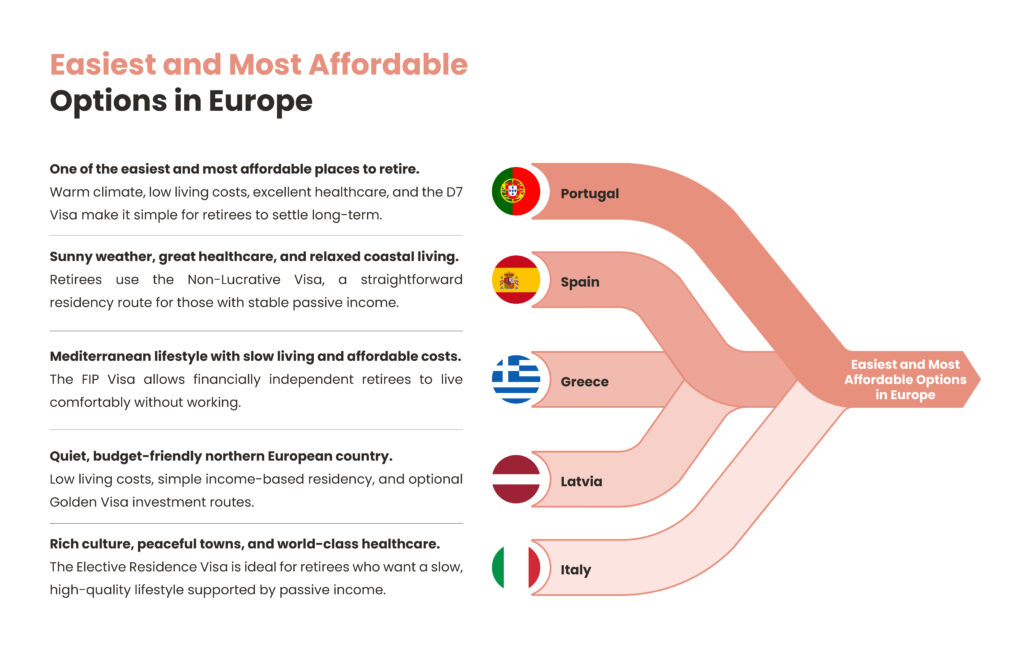
Easiest and Most Affordable Options in Europe
Here are some of the Easiest European countries to retire in and the Cheapest countries in Europe for retirees. These destinations offer simple visas, budget-friendly living, and strong expat communities.
These nations offer low-cost-of-living European cities, great Mediterranean weather, and some of the best small towns to retire in Europe.
1. Retiring in Portugal
Portugal remains one of the best places to retire in Europe. It offers warm weather, safe cities, and affordable living. Dining is cheap, transport is efficient, and basic utilities are affordable.
Healthcare is another major advantage. Public hospitals offer high-quality care at low cost. Private hospitals are also modern and widely available. Portugal’s nature and climate appeal to retirees who enjoy outdoor activities such as walking, cycling, or sailing.

Portugal Retirement Visa: The D7 Visa Explained
The Portugal D7 Visa is Portugal’s dedicated passive income visa, and the route most retirees use to settle in the country long term. It’s not officially branded a “retirement visa,” but it functions as one: no job offer, no large upfront investment, just proof of stable income from pensions, rental property, dividends, or savings.
Eligibility requirements:
- Be a non-EU national
- Have sufficient funds to support yourself while living in Portugal
- Maintain a clean criminal record
- Provide proof of a residence address in Portugal
- Spend at least 16 months in Portugal during the first two years
- Show stable passive income from one or more sources such as pensions, rental properties, dividends, royalties, or investments
Financial requirements (updated for 2026):
The required passive income is tied directly to Portugal’s national minimum wage. On January 1, 2026, that minimum wage rose from €870 to €920 per month, a €50 increase confirmed by Decree-Law No. 139/2025 and announced by the Portuguese government. That pushes the D7 income thresholds up as follows:
- Single applicant: €11,040/year (up from €10,440)
- Spouse: additional 50%, or €5,520/year
- Each dependent child: additional 30%, or €3,312/year
Source: Portuguese Government, Council of Ministers announcement, December 2025. The minimum wage is scheduled to rise again to €970 in 2027 and €1,020 in 2028 under the 2025-2028 tripartite income agreement, so applicants planning ahead should budget for further increases.
Processing and path forward: D7 applications typically take 4 to 8 months from submission to approval. The permit leads to permanent residency and Portuguese citizenship eligibility, though as of May 2026, Portugal’s Nationality Law reform doubled the standard naturalization residency requirement from 5 years to 10 years for most non-EU nationals (7 years for EU and CPLP nationals). This is the biggest recent change to Portugal’s long-term value proposition, and it applies regardless of which visa route you enter on.
This makes the D7 route one of the most accessible options for retirees planning long-term living in Portugal, even with the longer citizenship timeline now factored in.
2. Retiring in Spain
Spain is one of the most appealing retirement destinations in Europe. Warm weather, coastal towns, rich culture, and excellent healthcare attract thousands of retirees each year. Costs are moderate compared to Western Europe, making Spain a strong choice for people looking for comfort and an easy lifestyle.

Spain Retirement Visa: The Non-Lucrative Visa (NLV) Explained
The Non-Lucrative Visa (NLV) is Spain’s main retirement pathway. It allows non-EU citizens to live in Spain as long as they have enough passive income or savings, and no work of any kind is permitted, including remote work for a foreign employer (that falls under Spain’s separate Digital Nomad Visa instead).
Eligibility requirements:
- Be a non-EU/EEA national
- Must not engage in paid work or any professional activity in Spain
- Must have a clean criminal record
- Must hold comprehensive private health insurance covering all services in Spain
- Must show proof of sufficient financial means through passive income or savings to support yourself and any dependents
- Must have proof of accommodation
- Must spend at least 183 days per year in Spain after receiving the residence permit, which is also the threshold for Spanish tax residency
Financial requirements (confirmed current for 2026):
Spain ties the NLV income threshold to the IPREM (Indicador Público de Renta de Efectos Múltiples), its official public income index. The 2026 IPREM has remained frozen at €600/month (€7,200/year) since the 2023 State Budget, because no new budget law has been passed to update it, so the same figure has simply rolled over each year through 2026.
- Main applicant: 400% of IPREM, or €2,400/month (€28,800/year)
- Each additional family member: 100% of IPREM, or €600/month (€7,200/year)
Source: Spanish Ministry of Foreign Affairs, Consular Section. Note that this NLV threshold is different from Spain’s Digital Nomad Visa, which is based on Spain’s minimum wage rather than IPREM and currently sits at roughly €2,849/month, so don’t confuse the two if you’re comparing routes.
Processing and path forward: The initial NLV is valid for one year and renews in two-year periods, with permanent residency available after five years. Retirees can use pensions, rental income, dividends, savings, or investment returns to meet the requirement, and as of 2026, applicants can no longer convert from an NLV to a Digital Nomad Visa from inside Spain; that conversion now requires leaving and reapplying from a consulate abroad.
3. Retiring in Greece
Greece offers warm Mediterranean weather, charming villages, and great food. Healthcare is high quality and reasonably priced, making Greece one of the best Mediterranean countries for retirement.

Greece Retirement Visa: The FIP Visa Explained
Greece doesn’t officially call anything a “retirement visa.” Instead, non-EU citizens use the Financially Independent Person (FIP) Visa, now formally known as the Residence Permit for Persons with Sufficient Financial Means, though FIP is still the name everyone uses in practice. It allows retirees to live in Greece without working, based purely on proof of stable passive income.
Eligibility requirements:
- Must be a non-EU/EEA national
- Must not engage in paid work or professional activity in Greece; income must be passive
- Must hold a clean criminal record
- Must have private health insurance with full coverage in Greece
- Must show sufficient passive income or savings to support yourself and dependents
- Must provide proof of accommodation, such as a rental agreement or property documents
- Must spend at least 183 days per year in Greece to maintain the residence permit
Financial requirements (confirmed current for 2026):
The FIP threshold was last revised under Law 5038/2023 (Greece’s Immigration Code), Article 163, paragraph 8, and has held steady through 2026:
- Main applicant: €3,500/month (€42,000/year)
- Spouse: additional 20%, or roughly €700/month
- Each dependent child: additional 15%, or roughly €525/month
Source: Greek Ministry of Migration and Asylum; requirement codified under Law 5038/2023, Art. 163(8) and Ministerial Decision 225679/2024. These figures can vary slightly by consulate, so it’s worth confirming the latest with the Greek consulate handling your application before you file.
Processing and path forward: The FIP permit is valid for three years (extended from two years under 2024 reforms) and renewable for equal periods, with a pathway to permanent residency after five years and Greek citizenship after seven. Retirees under the FIP visa can also apply for Greece’s flat 7% tax rate on foreign pension income for up to 15 years, which is one of the more attractive tax arrangements on this list.
4. Retiring in Italy
Italy has a way of pulling people in. It’s not only the famous places you see in photos, but the quieter moments: the small cafés, the slow mornings, the old neighborhoods where everyone knows everyone. Italy is one of the richest countries in the world, and its medical care reflects that quality.
Most days can be simple. You might go for a walk, stop at a local market, or sit in a small square with a coffee. Italy offers beaches, mountains, lakes, and countryside, depending on what you prefer. Fresh food and healthcare are strong points too: the public system is solid, and private care isn’t hard to access if you prefer it.
Italy Retirement Visa: The Elective Residence Visa (ERV) Explained
Italy doesn’t officially have a “retirement visa” either, but the Elective Residence Visa is the option retirees use. It’s meant for people who want to live in Italy without working, so income has to come from pensions, rentals, dividends, or savings, never employment.
Eligibility requirements:
- Be a non-EU national
- Show stable passive income such as pensions, rental income, dividends, or savings
- Not work or run a business in Italy
- Provide a clean criminal record
- Have private health insurance valid in Italy for at least one year
- Show proof of accommodation, such as a rental contract or property ownership
- Prove that you can support yourself and dependents without employment
Financial requirements (confirmed current for 2026):
Italy doesn’t publish one fixed number that applies across every consulate; the requirement is assessed consulate by consulate, generally in this range:
- Single applicant: minimum €31,000 to €32,000 per year
- Couples: minimum €38,000 per year
- Each dependent child: income requirement increases by roughly 20% per child
Source: Italian Consulate General, official consular network (esteri.it). Because this varies by consulate, it’s worth checking directly with the Italian consulate covering your country of residence before applying, and building in a margin above the stated minimum.
Processing and path forward: ERV applications typically take 30 to 90 days to process, though the Ministry allows consulates up to 90 days by law. The visa itself is valid for 365 days and renewable annually as a residence permit, with permanent residence available after 5 years and full citizenship after 10. It’s worth noting that Italy’s Constitutional Court upheld a separate law (Law 74/2025) in March 2026 restricting citizenship by descent to two generations, but that change doesn’t affect the Elective Residence Visa route at all.
5. Retiring in Latvia
Latvia is a calm and affordable country in Northern Europe. It offers quiet towns, clean air, and easy access to nature. Riga is popular among expats, while smaller towns offer even lower living costs. Crime rates are low, and healthcare is affordable. Many retirees enjoy parks, forests, lakes, and long coastlines.
When it comes to living costs, Latvia is one of the most affordable EU countries. Healthcare is good and available in most towns. New retirees usually need private insurance at first, which is affordable. Property prices are low, making Latvia one of the cheapest places to buy property in Europe.
Latvia Retirement Visa: The Income-Based Residence Permit
Latvia doesn’t have a dedicated retirement visa. However, non-EU citizens can live in Latvia through a residence permit based on sufficient income, issued by Latvia’s Office of Citizenship and Migration Affairs (OCMA). This route suits retirees who have passive income, pensions, or savings and don’t plan to work in Latvia.
Eligibility requirements:
- Must be a non-EU national
- Must show stable passive income or savings
- Must not work in Latvia without a work permit
- Must show proof of accommodation
- Must have private health insurance
- Must submit a clean criminal record
Financial requirements:
Most applicants are expected to show at least €1,500 per month to cover daily living costs, with higher amounts typically requested for couples. Latvia’s income thresholds for different residence categories are set and periodically revised by the Cabinet of Ministers, so figures can shift between years. Confirm the current threshold for your specific application category directly with OCMA before applying, since Latvia has adjusted several income-based thresholds in 2025 and 2026.
Optional Path: Latvia Golden Visa (Investment Route)
Some retirees prefer an investment-based option instead of the income route. Latvia’s Golden Visa program grants residency through investment rather than proof of passive income.
This option isn’t required for retirement, but it offers faster processing and a 5-year residence permit.
Latvia Golden Visa investment options:
1. Business Investment: €50,000
- Invest €50,000 into a Latvian company
- The company must pay at least €40,000 per year in taxes
- Pay a €10,000 state fee
2. Real Estate Investment: €250,000
- Purchase property worth at least €250,000
- Pay a 5% state fee on the purchase price
Both options allow you to include your spouse and children under 18. The residence permit is valid for 5 years.
Best Small Towns to Retire in Europe
Some retirees prefer quiet, charming places. Here are great picks:
- Lagos (Portugal)
- Tavira (Portugal)
- Valencia outskirts (Spain)
- Chania (Greece)
- Jurmala (Latvia)
- Lecce (Italy)
How UNO Capital Assists
Retiring abroad requires planning. UNO Capital helps retirees at every step. The team guides you through choosing the right country, understanding visa requirements, preparing documents, and relocating smoothly.
UNO Capital also supports you with:
- Residency and visa applications
- Property search and investment guidance
- Tax consultation
- Healthcare and insurance recommendations
- Long-term settlement planning
Of the five destinations covered here, UNO Capital directly advises on Portugal (both the D7 Visa and Golden Visa) and Latvia’s investment residency route. For Spain’s NLV, Greece’s FIP visa, and Italy’s ERV, all direct government-to-applicant visas with no investment component, we can still point you toward trusted local partners as part of a consultation. With expert support, your move to Europe becomes simple and stress-free. Talk to a citizenship advisor!
Conclusion
Retiring in Europe means something different for everyone. Some people go for the slower pace, others like that most places feel safe, and a lot of folks just enjoy having dependable healthcare close by. It’s not one single thing; it’s a mix, and it depends on what you’re looking for at this stage of life.
Portugal, Spain, Greece, Italy, and Latvia show up again and again when people talk about the best places to retire in Europe. They’re easy to settle into, and for many retirees, they turn out to be genuinely affordable options without adding too much stress or complexity.
With the right plan and expert guidance, your dream European retirement can become a reality. Contact us today!
Conclusion
Portugal and Spain are generally considered the easiest, both offer income-based visas (the D7 and the Non-Lucrative Visa) with no local job offer or large investment required, just proof of stable passive income starting around €920 to €2,400 per month depending on the country.
As of January 2026, Portugal’s D7 Visa requires at least €920/month (€11,040/year) in passive income for a single applicant, tied to Portugal’s national minimum wage, plus 50% more for a spouse and 30% more per dependent child.
Yes, though timelines vary. Spain and Italy offer citizenship after roughly 10 years of residence, Greece after 7 years under the FIP route, and Portugal’s naturalization requirement was extended from 5 to 10 years under a May 2026 law reform (7 years for EU and CPLP nationals).
No. Portugal’s D7, Spain’s NLV, Greece’s FIP visa, and Italy’s ERV are all income-based routes that only require proof of stable passive income, not a lump-sum investment. Investment-based options like Portugal’s Golden Visa or Latvia’s Golden Visa exist as alternatives but aren’t required


